Everyday Skills and Life Management – 4 credits
In a folk high school, the school community provides young people with a safe environment in which to grow toward independence and take responsibility for themselves and the community. The social pedagogy of the folk high school strengthens young people’s functional abilities, learning readiness and skills, improves their life-management abilities in many ways, and promotes full and active citizenship.
Students also have a good opportunity to form lifelong friendships, which helps prevent social exclusion. One purpose of the programme is to create a safe study environment, where everyday skills can be practiced and also include, for example, gardening in autumn, helping to clean the institute’s dining hall, and using shared digital devices responsibly. When challenges arise in everyday skills or life management, they are discussed together and better ways of operating are sought.
Study, Self-Knowledge, and Working-Life Skills – 4 credits
During the compulsory education year, the study abilities of young people who have completed basic education are strengthened in preparation for upper-secondary studies, helping them find their own learning style and clarify their further study options. A change in learning environment gives the young person an opportunity to renew their identity as a learner and their sense of self-efficacy. Studying in a boarding folk high school also offers opportunities for critical reflection on what has been learned and experienced.
At the Finnish Bible Institute, students whose native language is other than Finnish, Swedish, or Sámi may receive Finnish as a Second Language (S2) instruction and be assessed accordingly. Students are also offered opportunities to become familiar with working life both in external workplaces and within the institute itself, such as the kitchen, bookstore, customer service, IT support, or property maintenance.
Interaction and Communication Skills – 4 credits
During the compulsory education year, young people strengthen their interaction and communication skills so that they learn to act purposefully, constructively, and ethically in different social situations. They learn to observe their own communication and identify their strengths and areas for development. The studies introduce the cultural and religious diversity of Finland and explore the meaning of identity. Living in a folk high school community naturally enhances social interaction and communication skills.
At the Finnish Bible Institute, the aim is friendly and polite interaction, and inappropriate speech is addressed. Students are guided to use appropriate language in all situations. Attention is given to how students communicate with each other, which must be respectful and not derogatory or discriminatory. This also applies to communication on social media.
Mathematical Basic Skills and Problem-Solving Skills – 4 credits
During the extended compulsory education year, students strengthen their logical-mathematical thinking and the mathematical skills acquired in basic education. They learn to approach problems from a mathematical perspective and solve them using mathematical methods. Studies make use of various problem-solving strategies, creatively explore cause-and-effect relationships, and teach students to justify their solutions. Essential mathematical concepts are reviewed for upper-secondary studies, and mathematical literacy is strengthened.
At the Finnish Bible Institute, practical tasks are used to practice mathematical skills—for example, comparing prices at a grocery store or using the cash register system in the bookshop.
Active Citizenship – 4 credits
During the compulsory education year, students gain the knowledge and skills needed to act democratically and according to the principles of sustainable living, both in their local community and as members of society.
Young people learn to understand their rights and responsibilities as individuals, as required by educational legislation. Boarding-school life also enables hobbies and personal interests to be combined with studies. Skills related to active citizenship help to prevent social exclusion and strengthen students’ sense of participation.
At the Finnish Bible Institute, students are encouraged to be active citizens in society and particularly within third-sector organizations such as churches and associations. Students become familiar with the core of Finnish democracy by visiting Parliament and meeting a Member of Parliament. Societal values and trends are discussed during lessons.
Study and Career Planning Skills – 4 credits
The extended compulsory education year in a folk high school is based on a personal study plan, which includes studies, personal guidance, student welfare services, and supervised living arrangements. A personal study plan is created for each student, defining the main goals and the necessary support (further studies, career planning, life-planning skills, study skills). The aim of study and career planning guidance is to help each young person find their own learning and career path and to motivate them for continued studies. During the year, learning readiness, study and working-life skills are strengthened, learning difficulties are identified, and young people are supported in making plans for future educational paths and finding motivation. In the folk high school environment, students experience belonging and improved wellbeing.
The diverse folk high school campuses offer extended compulsory-education students the opportunity to explore higher-education and working-life options. Folk high schools collaborate with various educational institutions and employers both regionally and nationally. Through visits and work-experience periods, students gain a comprehensive overview of different study and career opportunities, which helps them transition smoothly to the next stage of education.
At the Finnish Bible Institute, students receive support in clarifying their study and career plans throughout the year. They explore their strengths and interests both in terms of paid work and voluntary service. The institute emphasizes that all work is valuable and that everyone is called to serve with their gifts. Students hear about various career paths and visit local upper-secondary and vocational institutions. They are supported and encouraged throughout the application process for further studies.
Specialization Studies
Elective specialization studies are based on each folk high school’s strengths and priorities and are included in the local curriculum. They allow students to choose meaningful content and diversify their skills. Specialization studies can also address regional educational needs and may include joint modules created by several folk high schools. They deepen and broaden the skills learned in other study units.
Each folk high school has an operating license granted by the Ministry of Education and Culture, which defines the value base of its teaching. This value base may be reflected in the specialization studies, the institutional culture, and the free-time activities. The values must be transparent so that the student knows the value foundation of the school they are attending. For some students, this strong value base is a reason to choose a particular folk high school.
The diverse campuses may offer, as part of specialization studies, courses from upper-secondary or vocational education, as well as opportunities to explore higher-education studies. There may also be joint studies between different educational levels, which can be counted toward the extended compulsory-education year. Specialization studies may also be linked to the skills described in sections 5.1–5.7, with some of these skills learned through the specialization studies. These must be defined in the local curriculum, which must also specify the assessment criteria for the student’s competence in specialization studies. Below are examples of possible specialization-study learning objectives.
At the Finnish Bible Institute, extended compulsory-education students may choose specialization studies in the Musiikkilinja, Sportti PK, Nuorten Raamatun peruskurssi (PK). Students may also participate in the institute’s youth ministry activities, such as youth evenings.
Musiikkilinja
In Musiikkilinja, students develop their skills and gain readiness for further music studies. Music theory and practice go hand in hand. Students will progress on their chosen instrument. Through choir, ensembles, and bands, they become familiar with various musical styles and gain performance experience as well as support in managing stage fright. Christianity is naturally present throughout the studies. Collaboration and mutual support are essential elements of the program. Students also learn the biblical perspective on art, including music, and learn to reflect on their own thinking and contemporary trends in light of Scripture and the Christian worldview.
Sportti PK
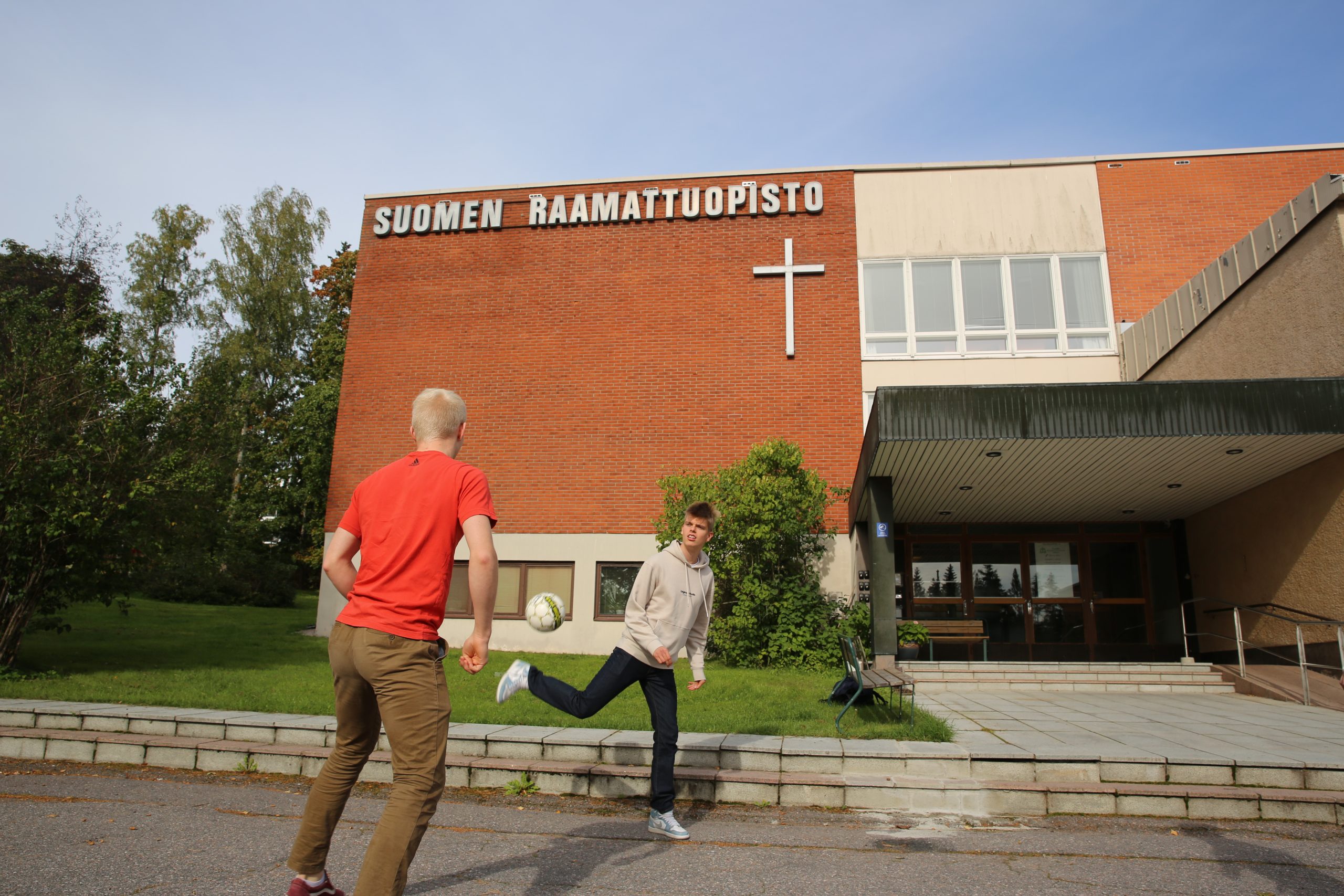
The Sportti PK aims to help students grow—and help others grow—physically, socially, mentally, and spiritually. The Bible is at the center of an athlete’s life, and students learn life-planning skills. Inspiring and trustworthy Bible teaching is a key part of growth as both an athlete and a leader. At the Finnish Bible Institute, students develop interpersonal skills and can explore sports such as football, floorball, basketball, volleyball, table tennis, and badminton. The goals include developing a positive body image, acting according to principles of equality and non-discrimination, and ensuring equal treatment of all. Students learn more about themselves through individual and group tasks and learn to function in a group. They explore their strengths and weaknesses and plan future career paths with support from teachers and peers. Students also learn about nutrition and its importance for health. The program can serve as a pathway into active sports participation and, for some, into a career in sports or physical education. Collaboration takes place with churches, Christian organizations, and various sports clubs.
Nuorten Raamatun peruskurssi
In the Nuorten Raamatun peruskurssi, students seek direction for life and build their worldview. They become familiar with the main themes of the books of the Bible and the central teachings of the Christian faith and Lutheran doctrine. The studies also include identity and career planning exercises, learning interpersonal and communication skills, and exploring mission work, pastoral care, and helping others.